 UNIVLABS
A governed learning corpus designed to expose the system to variation at global scale.
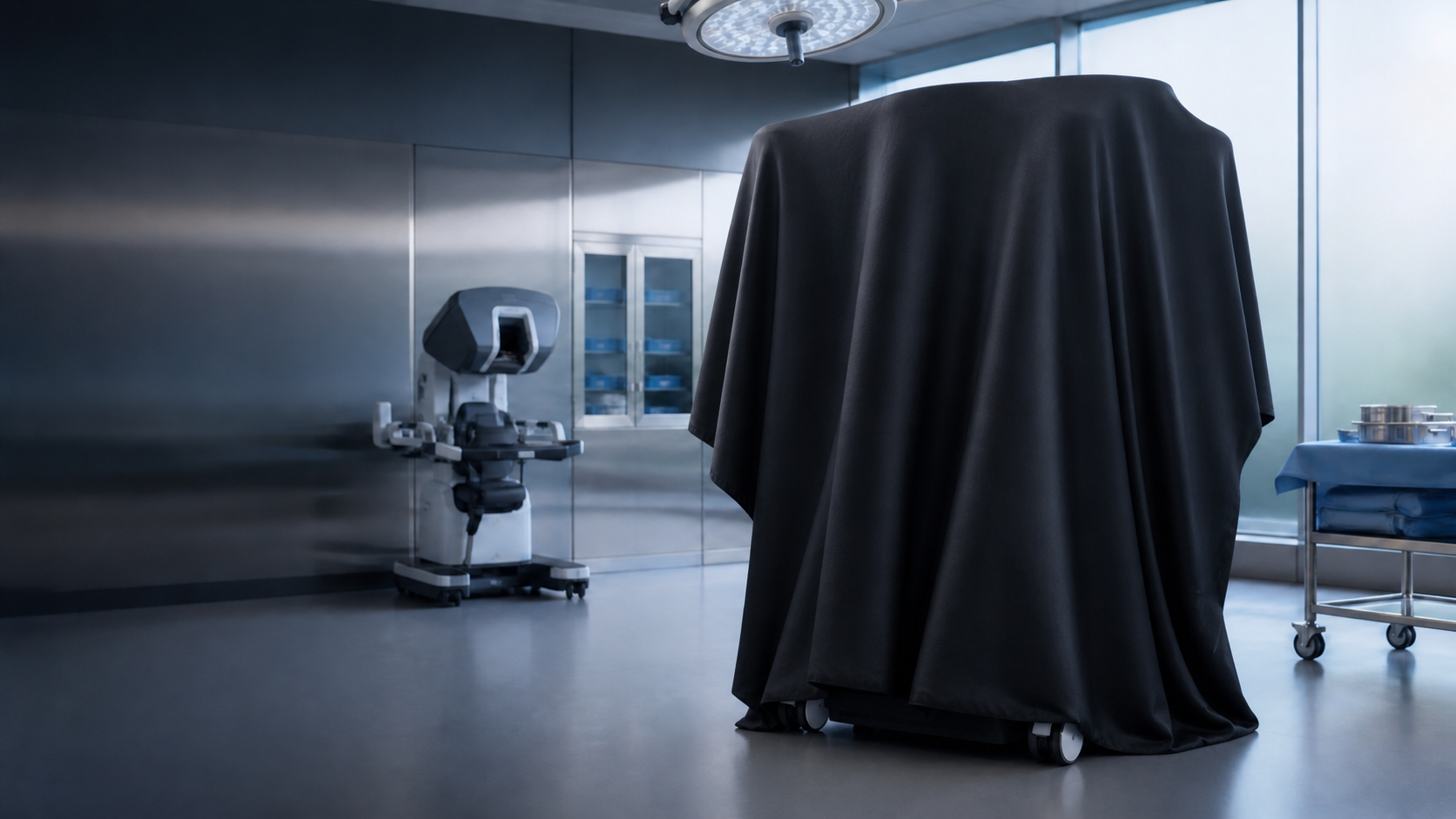
COGNISURGIBOT / SPARSH
UNDER DEVELOPMENT · 32 MONTHS REMAININGTHE AUTONOMOUS
SURGICAL ROBOT
A multi-arm robotic platform with a familiar operating-room form—but an intelligence architecture designed for progressive autonomy.
SEE HOW IT LEARNSDEVELOPMENT PROGRAMME · AWAITING UNVEILING · NOT CURRENTLY AVAILABLE FOR CLINICAL USE
THE FIRST-PRINCIPLES CASE
THE ARM IS NOT THE BREAKTHROUGH. THE LEARNING SYSTEM IS.
Precision robotics already exists. The unsolved problem is intelligence: understanding anatomy, anticipating the next surgical state, choosing a safe action and knowing when not to move. SPARSH is being built around that problem from day one.
Begin with repeatable tasks, prove safety, then compound capability procedure by procedure.
SECTION 01 / THE MACHINE
BUILT TO PERCEIVE, REASON AND ACT
SPARSH is conceived as a multi-arm surgical robot: articulated instrument arms, surgeon-grade vision and a compact operating-room platform. Its defining difference is inside—the ability to learn from governed surgical data and progress from assistance toward bounded autonomous action.
SEE
Fuse 4K, ICG and procedural signals into a live understanding of the surgical field.
UNDERSTAND
Recognise anatomy, instruments, workflow stage and safety boundaries.
PLAN
Select a validated sequence of movements for a defined surgical task.
ACT
Execute precise motion with continuous monitoring and human override.
SECTION 02 / LEARNING ENGINE
HOW SPARSH LEARNS FROM SURGERY
01CAPTURE→
02GOVERN→
03TRAIN→
04VALIDATE→
05DEPLOY→
06IMPROVE
ClearView systems capture consented surgical signals. CogniAxis.AI de-identifies, structures and labels the data; models learn surgical anatomy, workflow and expert technique; simulations and controlled studies test performance before any bounded capability reaches the robot.
The intended scale of the CogniAxis.AI learning corpus, subject to lawful access, consent, de-identification, quality controls and clinical partnerships.
Each validated deployment can return governed performance data to improve the system.
SECTION 03 / 2030 ROADMAP
EARLY PROCEDURE TARGETS
The programme is expected to begin with repeatable, lower-complexity tasks and selected procedural steps—not unrestricted autonomous surgery.
DIAGNOSTIC LAPAROSCOPY
Systematic visual survey, landmark recognition and documentation.
LAPAROSCOPIC SUTURING
Needle positioning, bite placement and knot-tying in defined settings.
SIMPLE APPENDECTOMY STEPS
Identification, controlled dissection and closure under human supervision.
CHOLECYSTECTOMY ASSISTANCE
Exposure, anatomy recognition and selected standardised steps.
INGUINAL HERNIA REPAIR STEPS
Mesh positioning and repeatable suturing tasks in selected cases.
TISSUE RETRACTION & CAMERA CONTROL
Stable visualisation and coordinated instrument positioning.
TURP ASSISTANCE
Resection-boundary recognition, camera control and selected repeatable steps under specialist supervision.
HYSTEROSCOPY
Structured uterine-cavity survey, lesion localisation and selected instrument-navigation tasks.
2030 targets are development ambitions, not clinical promises. Scope and timing will depend on engineering validation, clinical evidence, ethics review, regulatory authorisation, patient selection and human oversight.
SECTION 04 / RESPONSIBLE AUTONOMY
HUMAN CONTROL AT EVERY STAGE
✓ Surgeon override✓ Defined operating boundaries✓ Continuous safety monitoring✓ Traceable decisions✓ Progressive clinical validation✓ Regulatory pathway
SPARSH will advance through supervised task autonomy before any consideration of broader procedural autonomy.
DISCUSS SURGIBOT