Small spaces. High stakes.
Tight cavities, weak fluorescence and glare demand sensitive imaging—without simply adding more light and heat.
 UNIVLABS
 / MEDICAL SEMICONDUCTORS
A good picture is not enough.
The signal must be dependable.
WHY SPECIALISED PROCESSING?
Consumer-camera processing alone does not establish medical suitability. Surgery needs controlled colour, spectral calibration and timing—not just an attractive image.
Tight cavities, weak fluorescence and glare demand sensitive imaging—without simply adding more light and heat.
Multispectral and hyperspectral imaging need matched optics, sensors and calibrated processing—not a software colour filter.
Robotics and 3D vision need synchronised images and predictable low latency. Global shutter is one sensor option; it is not an ISP feature.
FIRST DEVELOPMENT PRIORITY
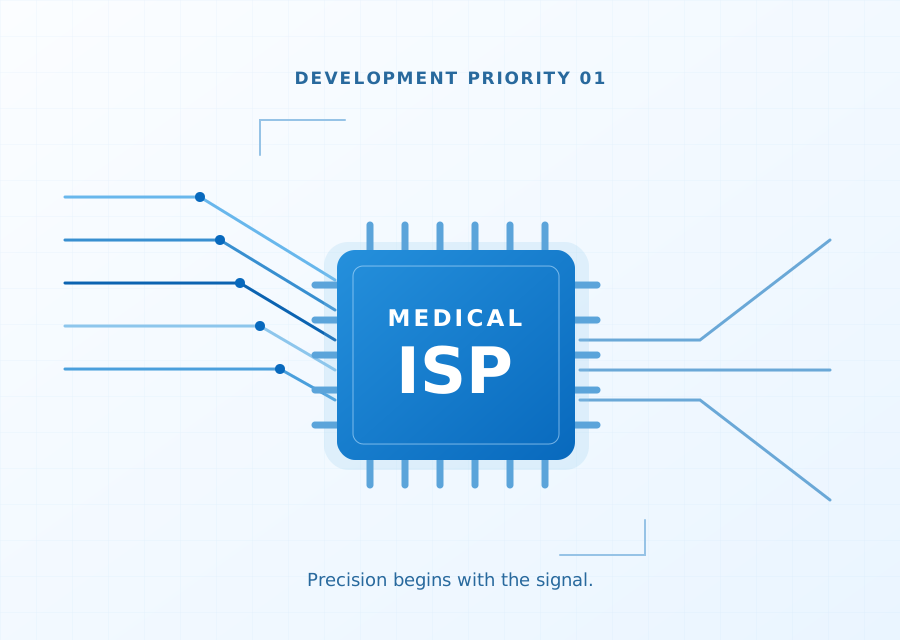
An image signal processor built around surgical needs. Our development targets: colour consistency, controlled noise reduction, calibrated spectral processing and predictable latency.
Imaging first. Continence sensing remains our other focused research direction.
BUILT FROM THE SIGNAL UP.
Primary semiconductor and medical-imaging sources. External research does not imply endorsement or validation of UnivLabs’ programme. Commercial CMOS can be part of a medical design; the complete system must meet its intended clinical requirements.
Development targets—not validated specifications, an available medical product or a claim of autonomous surgical capability.